
Novel Accelerator Diagnostics Using Cherenkov Radiation (submitted)
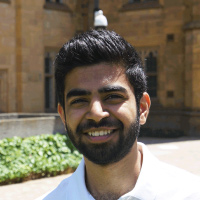
I’m Paarangat Pushkarna, a first year PhD student at the University of Melbourne and the Australian Synchrotron. Before starting my PhD in 2023, I worked as a lab assistant in the CERN ATLAS collaboration, and as a 4-month research intern in the University of Melbourne X-Ray Optics Group. I completed my undergraduate degree in Mathematical Physics, and my Masters in Physics, both at the University of Melbourne.
I was born in New Delhi, and at the age of eight moved with my parents to Brisbane, Australia. My interest in Physics and Maths was piqued in high school, at the Queensland Academy for Science, Maths and Technology, and I am extremely grateful to my teachers for this. They all instilled in me a self-belief that enabled me to undertake Physics at University.
I developed a keenness for research in my final year of high school, where, over 6 months, I studied sound waves in open pipes. I remember as a 17 year old being buoyed by excitement when I realised I could use white noise to simultaneously excite all resonances in the pipe, instead of scanning over frequencies to find the resonances. Little did I know I would study resonance and the wave equation in much greater detail at University.
When I’m not thinking about Physics or complaining about my own poorly documented code, I enjoy playing pick-up games of football with friends, and sampling Melbourne’s diverse coffee culture. I also enjoy live music, and to those visiting Melbourne I can recommend Section 8, Bar Oussou, The Old Bar, and Cherry Bar as excellent live music venues. One thing I cannot recommend is Melbourne’s cold, temperamental weather, which makes me miss Brisbane’s tropical climate dearly.
Currently, in my PhD project, we consider the development of a diagnostic device to measure bunch lengths of 100MeV electron bunches at the Australian Synchrotron. We consider how this diagnostic device may also be used for breakdown detection and analysis at the University of Melbourne X-band Laboratory for Accelerators and Beams (X-LAB).
Our diagnostic device exploits the Cherenkov effect in dielectrics to measure bunch length and detect breakdowns. When relativistic electrons are incident upon the dielectric, Cherenkov radiation is generated, and radiation intensity is proportional to bunch charge. As a result, bunch properties can be inferred from the detected Cherenkov light.
Currently, no bunch length diagnostic devicess are in place at the 100MeV linac of the Australian Synchrotron. Therefore, bunch length re-construction to pico-second resolution will greatly benefit Synchrotron users, as well as beam quality in the storage and booster rings. Additionally, this diagnostic device could enable prediction of breakdown events in RF cavities using electrons ejected during electrical vacuum breakdown. This could improve and shorten the RF cavity conditioning process, reducing power consumption and improving sustainability of RF cavity fabrication.
PhD Supervisors: Matteo Volpi [1], Eugene Tan [2], Rohan Dowd [2], Suzie Sheehy [1,2], Geoffrey
Taylor [1]
[1] X-Band Laboratory for Accelerators and Beams (X-LAB), The University of Melbourne
[2] Australian Nuclear Science and Technology Organisation, ANSTO
“C’est fascinant de voir la collaboration entre l’Université de Melbourne et l’Australian Synchrotron! Ce type de partenariat entre les institutions académiques et les installations de recherche de pointe est essentiel pour l’avancement scientifique. En parlant de recherche et d’éducation supérieure, ça me rappelle que j’ai vu un lien intéressant concernant les coûts des études universitaires à Jakarta : https://jakarta.telkomuniversity.ac.id/en/how-much-does-public-vs-private-college-cost/“>Telkom University Jakarta. C’est intéressant de comparer les priorités et les investissements dans la recherche et l’éducation dans différents pays. Merci pour cet article instructif!”
How did your early experiences with sound waves in high school shape your current research focus as a PhD student at the University of Melbourne and Synchrotron?
Regard Teknik Logistik