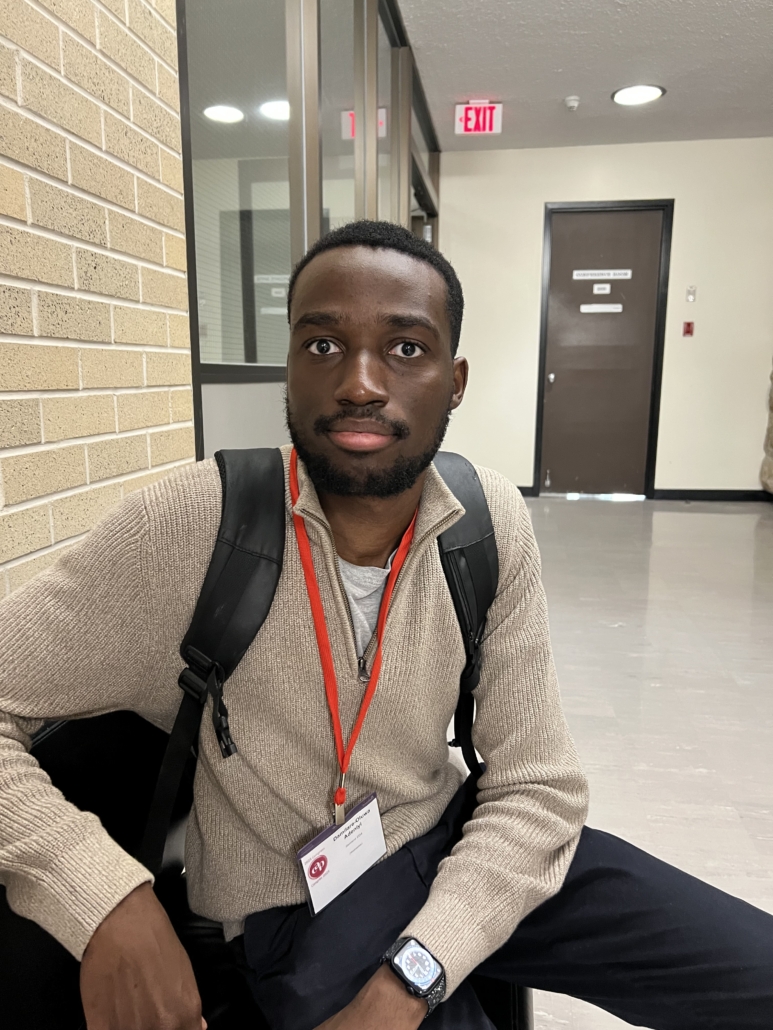
An Audio Interview with Damilare-Oluwa Adenyi, Siemens EDA
The week of June 8-13, 2025, I was in Saskatoon, Saskatchewan, Canada for the Canadian Association of Physicists (CAP) conference, and I was struck by the talk given by Damilare-Oluwa Adeniyi during an industry session on June 11th. I was intrigued by his work to identify either: (i) global level defects in Silicon wafers used to make computer chips, or (ii) very specific single transistor errors in these same wafers. As a consequence, I asked for an audio interview, Damilare kindly agreed, and our discussion follows below.
Note: Following the audio link are time stamps for each question asked, and the first few words of response. These are provided in case people would like to go to a specific question within the audio interview.
Question 1 (00:00): What is your role?
Software developer at Siemens EDA, and I work on circuit characterization …
Question 2 (01:00): From your talk today, I understood you are looking at finding errors in chip design in a global sense. Could you describe this?
During the design process, the characteristics of the material affect all of the transistors on a wafer. This would be a global variation …
Question 3 (01:29): I come from the ion implantation side of the business, so, if there was a wafer doping issue, would that be then a global problem?
Yes, exactly, global means across a whole wafer or a batch of wafers …
Question 4 (02:20): Now what are more specific errors that you are looking for on a chip or wafer?
You can think of it as one transistor having an issue …
Question 5 (03:21): How do you assess a billion transistors in a chip?
You can end up with trillion x trillion arrays of electrical characteristics that need to be assessed …
Question 6 (04:38): How do you use machine learning (Artificial Intelligence) to solve those problems?
So, for a PVT (Process, Voltage, Temperature) look up table over many trillion x trillion arrays …. use machine learning to quantify the results …
Question 7 (05:44): What characteristics would you be interested in for a new hire?
You should be able to solve problems, and physics students should have the confidence to apply even if it is for an engineering role …
Question 8 (05:35): You grew up in Nigeria. Is that where you finished high school?
So, I finished high school in Nigeria, and then I went to the University of Saskatchewan and took Engineering Physics …
Question 9 (08:25): Who was the Professor that inspired you?
It was Professor Doug Degenstein.
Question 10 (09:05): Did you get hired right away after graduation?
Yes, it worked out well, I secured a job four months before graduation … with Siemens EDA …
Question 11 (09:40): Is there a characteristic from your childhood that you still see in yourself now?
As a kid, I liked designing, and initially I thought I would be an architect … I loved Ironman and the whole Marvel Industry …
Question 12 (10:50): What do you like about living in Saskatoon?
I grew up in Lagos, Nigeria, which has 22 million people cramped in one city … Saskatoon is quiet … it is welcoming … I’ve started camping in the last few years …
It was a great pleasure to interview Damilare-Oluwa Adeniyi, and I was grateful for his insights regarding efforts to detect, assess, and understand errors in Silicon wafer production. It is something I knew very little about previously. I wish him well in his career!