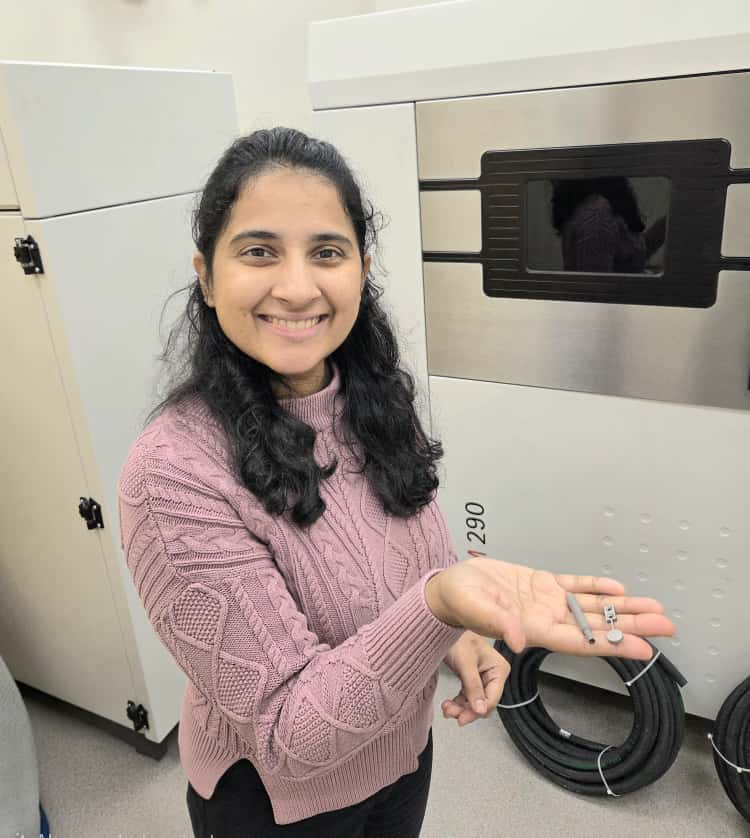
An Audio Interview with Dr. Sravya Tekumalla, Assistant Professor, Mechanical Engineering, The University of Victoria
It was great to present a lecture in Dr. Tekumalla’s https://www.uvic.ca/ecs/mechanical/faculty-staff/faculty-profiles/tekumalla-sravya.php UVic MECH 422 class on Advanced Materials and Processes entitled “Materials Modification through Ion Implantation” on October 31, 2025. It was equally wonderful to visit her laboratory, where the latest in additive advanced manufacturing 3D metal printing can be undertaken.
Dr. Tekumalla also kindly granted an audio interview, and the link follows this paragraph. Below the link are time stamps of my questions, and the first few words of answers, as a guide to the topics we discussed.
Question 1 (00:00): What is your role and job?
I am an Assistant Professor in the Mechanical Engineering Department, … and I lead a Sustainable Metal Additive Research Team (SMART) …
Question 2 (02:35): Does additive mean 3D printing?
Yes, and additive manufacturing means building layer by layer in 3 dimensions …
Question 3 (02:54): And these parts can be just as good as “machined” parts?
It depends on the type of technology we are using ….
Question 4 (03:38): When you speak of resolution, you mean?
Minimum features we can print ….
Question 5 (06:40): What does your research team bring to our co-supervised Master’s student, Robert Gagnon, (MITACS funded with commercial partner D-Pace) who will be undertaking experiments related to ion implantation at the Selkirk Ion-source Research Centre’s Penning Ion Source test stand?
The way these materials solidify is they generate a lot of defects including cells, dislocations, and structures, … and though defect sounds bad, they can improve properties in the material …
Question 6 (08:10): So, since you are 3D printing you can control these defects?
Yes, … this can, for example, double the hardness of a part as compared to a machined part …
Question 7 (09;29): This caught my attention, you can print a part of different compositions?
There are many ways to do this, one way is multi-material printing …
Question 8 (12:40): How do you feel your research area could affect the world of particle accelerators?
The way the metal additive manufacturing space has evolved right now, it won’t replace casting, but it will have an impact on niche parts …
Question 9 (14:05): Through subtractive manufacturing, such as machining, I could never make a progressively changing material or part…
You could never do that, no.
Question 10 (14:10): What is your background? How did you get to this position at UVic?
I grew up in India, and my Bachelor degree is in Metallurgical and Material Science Engineering, … and then I went on to a PhD at the National University of Singapore …
Question 11 (17:40): You mentioned that you found the process of accepting at UVic in Canada quite welcoming, and that affected your decision?
UVic and Canada I must say has been very welcoming … I had no experience regarding Canada … they were very supportive in all the work permit processes for myself and my spouse …
Question 12 (19:26) What are a few things about the Victoria area that grab you or interest you?
Victoria is on an island like Singapore, but it is more laid back … and the city itself is extremely beautiful … at UVic the department I am in is very diverse, so there are a lot of opportunities for cross-pollination …
Question 13 (21:35): Is there some characteristic from when you were little that you still find in yourself as a scientist?
Curiosity a little bit …
Question 14 (22:20): Can you remember a story from when you were a kid, when you exhibited curiosity?
Yeah, I was going around building little kaleidoscopes …
I was very grateful for the time Sravya set aside for this interview, and her insights and anecdotes were very interesting and inspiring. I am very much looking forward to collaborating with Sravya for many years to come, and I look forward to seeing what innovations will come to ion source and particle accelerator science by way of additive metal printing!!