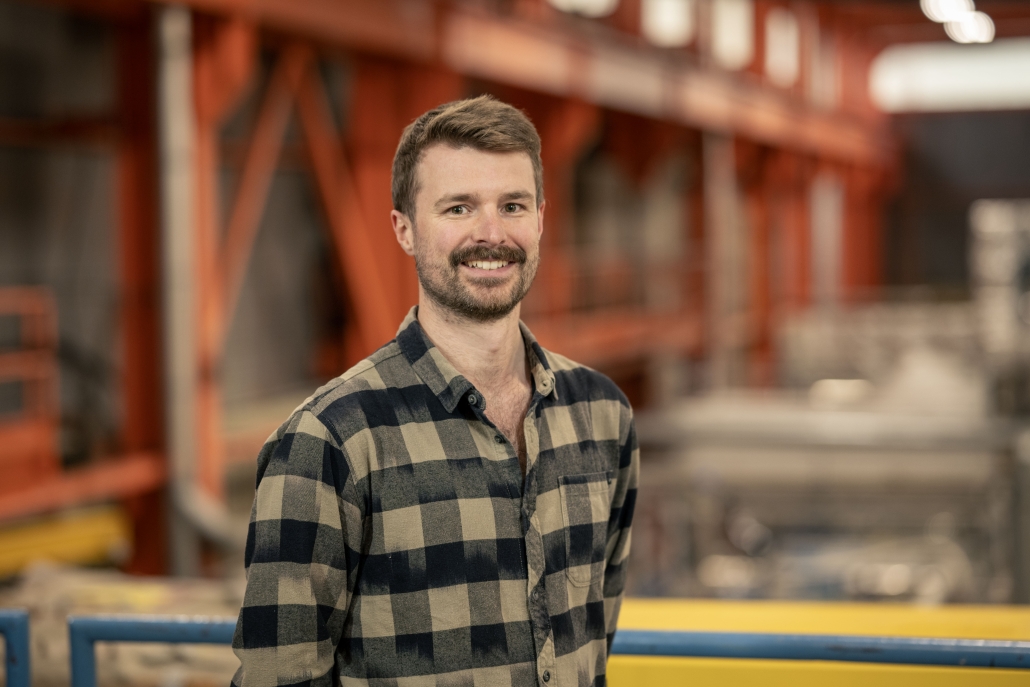
The Importance of Neutrons for Nuclear Astrophysics per Dr. Chris Griffin, Research Associate, TRIUMF (submitted)
We need neutrons. Lots of them.
Stars like our sun fuse successively heavier elements over their lifetime to generate the energy required to support them and that provides for life here on Earth. However, due to the increasing Coulomb repulsions between the nuclei involved, this process cannot proceed beyond iron. Simple observations of the world around us tell us that this cannot be the end of the story though, as we know elements exist beyond iron – from the gold in our jewelry, to the exotic metals in our phones, or the lead shielding used in physics labs around the world.
It is thought that nucleosynthesis beyond iron is achieved through the successive capture of neutrons by nuclei around iron, and their subsequent β-decay, via the slow-, intermediate-, and rapid-neutron capture processes [1, 2]. The slow neutron capture process takes place in (relatively) low neutron density environments and the capture timescales are slow relative to the half-lives of the nuclei involved. So, after capturing a neutron, the new isotope has time to decay back towards a stable isotope and this process proceeds along a path very close to stability. The rapid process takes place in extremely high neutron density environments like supernovae and the collisions of neutron stars. The neutron capture rates in the rapid process are much faster than the β-decays and the isotopes capture many neutrons, creating very exotic neutron-rich nuclei, before they decay back to stable isotopes. As its name suggests, the intermediate process is somewhere between the other two, following a path a few isotopes away from stability, although the astrophysical site is still up for debate.
Studying these neutron capture processes is key to deepening our understanding of nucleosynthesis and the elemental abundances and chemical diversity we see across our galaxy. However, it is also very technically challenging. Many of the nuclei of interest are far from stability and very short-lived. Free neutrons are also radioactive, with a half-life of only around 11 minutes.
Traditionally, to study reactions in which one nucleus reacts with another, we would construct a target out of one material and hit it with a beam of the other. This is not easily achievable when both species are radioactive, as is the case with the neutron capture of radioactive nuclei – we cannot make a fixed target of free neutrons, nor one of a short-lived isotope. Instead, we have taken to looking at the decays of neutron-rich nuclei and combining what we learn with theory to try and probe neutron capture reactions. A few key quantities of interest to my research are the nuclear masses, neutron capture probabilities, β-decay half-lives, and β-delayed neutron emission probabilities of neutron-rich nuclei.
In β-delayed neutron emission, residual energy from the β-decay can be great enough to remove one or more neutrons from the daughter nucleus, shifting the decay path back to stability and changing the final abundances. In order to determine the probability of a given nucleus emitting one or more neutrons during its decay, we have the challenging task of observing that decay and measuring any neutrons emitted. This is particularly challenging because of the neutral nature of the neutron and the fact that they deeply penetrate many materials without depositing much detectable energy.
Due to the difficulty in producing very exotic nuclei and the difficulties in detecting neutrons, studies of β-delayed neutron emission are highly collaborative and can only take place at select labs around the world capable of producing the neutron-rich isotopes of interest. I have been lucky enough to be involved in several collaborations that have conducted β-delayed neutron emission measurement campaigns across wide swaths of the chart of nuclei – from the BRIKEN collaboration [3, 4] previously active at the RIKEN facility in Tokyo, to my involvement with the GRIFFIN and DESCANT [5, 6] detectors at TRIUMF, and my more recent work developing detectors for use at the Experimental Storage Ring (ESR) at GSI in Germany.
The opportunity to travel and visit other labs around the world is an aspect of my job I absolutely love. While working towards a common goal, each lab operates slightly differently – be it the size of the lab; how they produce radioactive isotopes; what detectors and equipment are used to carry out experiments; or simply the culture, food, or language of the country the lab is based in. Every visit to another lab is an exciting opportunity to experience something new both professionally and personally.
For me, the holy grail of neutron-capture studies is to directly measure the probability of neutron capture by short-lived radioactive nuclei and this may finally be on the horizon. An exciting project I am involved with at TRIUMF aims to try achieve this by coupling neutron generators to a storage ring. Storage rings, as their name suggests, store ions in a ring. They use magnetic elements to bend and focus ions within the ring and can include various non-destructive measurement techniques to allow users to measure nuclear properties while maintaining storage of the circulating ions.
The TRISR [7] project aims to build a storage ring at TRIUMF and add an array of neutron generators around a section of the ring, constantly producing a high flux of thermal neutrons that the circulating ions will pass through hundreds of thousands of times a second. The neutron generators will use either deuterium-deuterium (DD) or deuterium-tritium (DT) fusion, in which ions of D or T are accelerated by an ion source into a target loaded with other atoms of D or T, fusing to produce He and a neutron. Their use allows us to address the challenges of producing either a target of neutrons or radioactive isotopes by constantly generating neutrons and flushing and refilling the storage ring as the stored isotopes decay. By separating and identifying isotopes that capture a neutron, then comparing the number of them to the number of unreacted isotopes, we can then calculate the probability of capture.
This will be a unique facility worldwide, with the aim studying isotopes with half-lives as short as seconds and allowing access to nuclei important for the neutron capture processes.
Much of my research during my PhD at the University of Edinburgh and my time as a postdoctoral researcher at TRIUMF has been focused on the detection of neutrons following radioactive decay and, more recently, producing neutrons to observe neutron capture on radioactive nuclei. However, neutrons have many applications outside of academia including contraband detection [8], nuclear waste transmutation [9], and their use in cancer treatments such as Boron Neutron-Capture Therapy (BCNT) [10].
So despite the many frustrations I may have had over the years while trying to detect neutrons, and my continued frustrations while trying to pursue direct neutron capture measurements, I still think neutrons are endlessly useful and fascinating particles.
To try shed these frustrations, I have adopted many of the quintessential BC hobbies since my move to Vancouver from the UK and now spend most of my time away from work in the mountains, either hiking in the backcountry, snowboarding, cycling or climbing. I still haven’t quite found the perfect ratio of chocolate to nuts in my trail mix though.
[1] E. M. Burbidge, et al. “Synthesis of the elements in stars.” Reviews of Modern Physics 29.4 (1957): 547.
[2] J. J. Cowan, W. K. Rose. “Production of C-14 and neutrons in red giants.” Astrophysical Journal 212 (1977): 149-158.
[3] A. Tarifeño-Saldivia, et al. “Conceptual design of a hybrid neutron-gamma detector for study of β-delayed neutrons at the RIB facility of RIKEN.” Journal of Instrumentation 12.04 (2017): P04006.
[4] A. Tolosa-Delgado, et al. “Commissioning of the BRIKEN detector for the measurement of very exotic β-delayed neutron emitters.” Nuclear Instruments and Methods in Physics Research Section A 925 (2019): 133-147.
[5] A. B. Garnsworthy, et al. “The GRIFFIN facility for Decay-Spectroscopy studies at TRIUMF-ISAC.” Nuclear Instruments and Methods in Physics Research Section A 918 (2019): 9-29.
[6] P. E. Garrett. “DESCANT–the DEuterated SCintillator Array for Neutron Tagging.” ISAC and ARIEL: The TRIUMF Radioactive Beam Facilities and the Scientific Program (2014): 137-141.
[7] I. Dillmann, et al. “Measuring neutron capture cross sections of radioactive nuclei: From activations at the FZK Van de Graaff to direct neutron captures in inverse kinematics with a storage ring at TRIUMF.” The European Physical Journal A 59.5 (2023): 105.
[8] J. E. Eberhardt, et al. “Fast neutron radiography scanner for the detection of contraband in air cargo containers.” Applied Radiation and Isotopes 63.2 (2005): 179-188.
[9] S. Leray. “Nuclear waste transmutation.” Nuclear Instruments and Methods in Physics Research Section B 113.1-4 (1996): 495-500.
[10] M. A. Dymova, et al. “Boron neutron capture therapy: Current status and future perspectives.” Cancer Communications 40.9 (2020): 406-421.